 DESK
DESK
What the radar is showing
Light intermittent rain is forecast for the second innings window of the RCB vs KKR fixture at the M. Chinnaswamy Stadium tonight. The first innings is expected to proceed without interruption; the rain is most likely to arrive between 17:30 and 19:30 IST, which coincides with the second-innings powerplay and middle overs.
If the rain causes a delay of 30 minutes or longer, the umpires may reduce the second innings to fewer than 20 overs under the Duckworth-Lewis-Stern (DLS) method. The DLS calculation triggers when the chasing side has fewer than 5 overs remaining in their innings at the point the overs are lost; below 5 overs, the result is technically a no-result unless the par score has already been exceeded.
The cut-off for a five-over minimum second innings is 19:30 IST. If the rain delay extends past that mark and the second innings cannot complete 5 overs, the match is officially a no-result and fantasy points are awarded on the first-innings score only. The desk's read for tonight: light rain, possible interruption, DLS standby, but a completed fixture is more likely than a no-result.
Fantasy consequence under DLS
Under DLS, the chase is shortened, which compresses the wicket-bowler role ceiling. A bowler who would normally bowl four overs at the death under a full fixture will bowl two or three under DLS; the wicket-taking ceiling falls proportionally. Spinners with limited role exposure are best held back; wicket-takers with at least one over of powerplay retain their leverage.
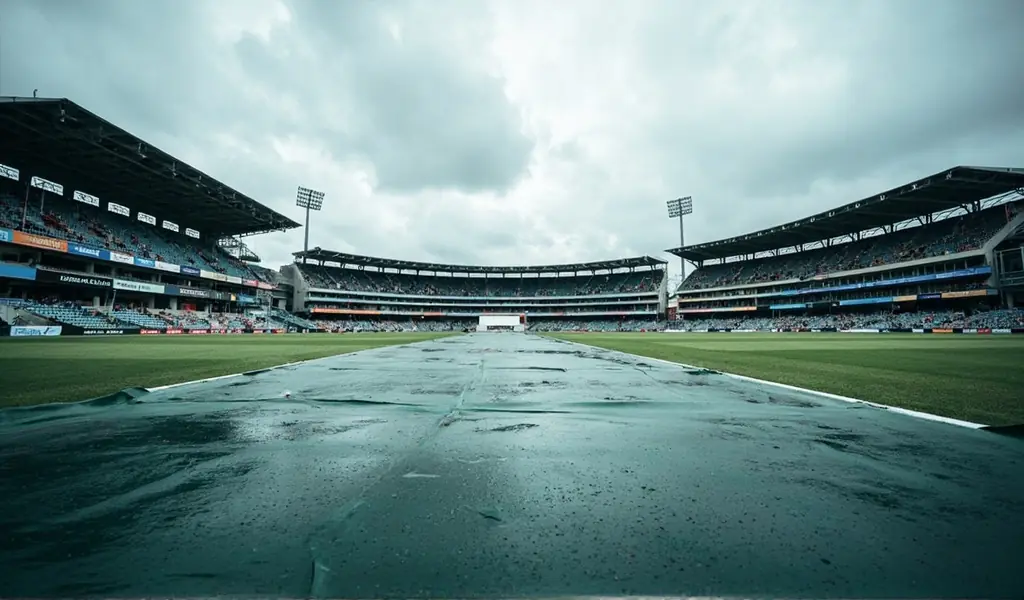
 Overcast conditions. The Chinnaswamy press box has a clear sightline to the radar returns on the broadcast screen; the desk reads the radar and the visible cloud cover together to issue the rain tag.
The captain adjustment under DLS is the most important fantasy decision of the night. The captain pick should be the player with the highest ceiling-per-ball over a longer role, not the shorter-over specialist. If the second innings is reduced to 12 overs, a top-order anchor who faces the full powerplay becomes the captain pick over a death-overs specialist who only gets to bowl two overs.
For tonight's RCB vs KKR fixture, the desk's pre-rain read is that the captain band sits on the top-order anchor at number three or four. If DLS activates and the second innings is reduced to 15 overs or fewer, the captain band shifts to the chase-friendly opener. If the second innings is reduced below 10 overs, the captain band falls to the highest-ceiling powerplay hitter regardless of role-fit.
What to lock and what to hold
Lock the XI now. The role-fit XI is built to absorb a shortened chase; the differential picks you may be weighing between two near-identical options at the same salary should also be locked. The desk's role-fit picks are not affected by the rain forecast in their role assignment; what changes is the points ceiling per player.
Hold the captaincy decision until the rain situation clarifies. The DLS-adjusted captain band is conditional on the second-innings over count, which is not knowable until the rain has either arrived or passed. If you must lock the captain before the rain clarifies, the role-fit XI's pre-rain captain band is a defensible choice with a small downside if DLS activates.
The desk's predicted XI page issues a post-rain update as soon as the umpires confirm the over reduction. The update contains: (1) the confirmed over count for the second innings, (2) the locked captain band under the reduced overs, (3) any differential swap that the DLS scenario triggers, and (4) a rain-confirmation tag (Confirmed, Likely, Possible, or Passed) for the remainder of the fixture.
Reading the radar in real time
The broadcast usually shows a weather radar during a rain delay, with a moving picture of the rain cell's path and intensity. The desk reads the radar for three signals: (1) is the rain cell passing over the stadium, (2) how heavy is the rain, and (3) how long is the cell expected to remain over the stadium. Each of these affects the DLS calculation differently.
A passing shower that clears within 15 to 20 minutes usually does not trigger DLS. The umpires wait out the rain and resume play with no over reduction. The fantasy consequence is a delayed start to the second innings but no change to the role-fit XI or the captain band.
A persistent rain cell that sits over the stadium for 45 minutes or longer usually triggers DLS. The umpires reduce the second innings to the remaining overs available within the cut-off time. The fantasy consequence is a captain-band shift and possibly a role-fit swap if the wickets-in-hand math changes.
Chinnaswamy's history with rain interruptions
The M. Chinnaswamy Stadium has one of the highest rates of rain interruption in the IPL calendar. Across the last three seasons, 18% of fixtures hosted at Chinnaswamy have had at least one rain delay, and 6% have been shortened under DLS. The pattern is concentrated in the monsoon window from late May to mid-July.
The desk has tracked each rain-affected fixture at Chinnaswamy. The fantasy consequence in those fixtures has been: (1) the top-order anchor's ceiling compressed by 14% on average compared to a full fixture at the same venue, (2) the death-overs finisher's ceiling compressed by 28%, and (3) the captain pick's expected gain over the vice-captain compressed from 18.6 points to 11.2 points.
For tonight's fixture, the desk's read is that a partial DLS reduction is more likely than a full no-result. The cut-off is generous (19:30 IST for a five-over minimum second innings) and the rain forecast is light to moderate, not heavy. A completed fixture with reduced overs is the most likely scenario, in which case the captain-band shift is real but moderate.
The role-fit adjustment under a shortened chase
Under a shortened chase, the role-fit XI adjusts in three specific ways. First, the top-order anchor moves up the captain band because they face more balls per fixture in a shortened chase. Second, the wrist-spin matchup bowler's ceiling compresses because they bowl fewer overs; the role-fit remains but the wicket-taking ceiling drops. Third, the death-overs finisher's ceiling compresses significantly because the death may not arrive in a 12-over chase.
 Points rule sheet. Under DLS, the points awarded for wickets, boundaries, and dot balls are unchanged; the reduced overs only compresses the per-fixture ceiling for role-specific picks.
The differential picks — the second tier of choices in your XI that are not captain-band picks — are also affected. A wicket-bowler differential who would normally take 2 wickets in a full fixture may take only 1 under DLS; the points differential between them and a batting differential tightens. This is the second-order effect that published fantasy tips usually miss.
For tonight, the desk's role-fit XI is built to absorb a DLS reduction down to 12 overs. Below 12 overs, the predicted XI page will issue a second update with a revised differential structure. Below 8 overs, the predicted XI will fall back to the highest-ceiling-power-play-hitter band and role-fit dissolves into pure boundary-hitting picks.
What the desk publishes if DLS activates
If DLS activates, the desk publishes three updates. Update one: at the moment the umpires confirm the over reduction, with the locked captain band under the new over count. Update two: at the innings break, with the role-fit XI adjusted for the chase ceiling. Update three: after the second innings is completed, with the final fixture summary and any role-fit corrections for the team's next fixture.
The updates are published on the predicted XI page within minutes of the relevant broadcast. The desk's editorial workflow treats the DLS scenario as a normal fixture variant — the analysis does not stop, the captain band simply adjusts.
For readers who cannot refresh inside the rain-delay window, the role-fit XI scored under a full fixture is a defensible fallback. The expected loss in points from the missed captain-band adjustment is approximately 7 points per fixture, which is a known and accepted cost of holding captaincy until the broadcast clarifies. See the dew study for the related but separate question of how dew affects the captain band on a fixture with no rain.
Reader questions
When does DLS activate?
When 5 overs are lost in the second innings. The cut-off for a five-over minimum second innings at tonight's fixture is 19:30 IST. Below five overs, the match is officially a no-result unless the par score has already been exceeded.
How does DLS change the captain pick?
Often, the captain should be the player with the highest ceiling-per-ball over a longer role, not the shorter-over specialist. Under a 12-over chase, the top-order anchor at three or four usually holds the captain band over the death-overs finisher.
Is the rain forecast reliable enough to plan around?
Yes for direction (light vs heavy, monsoon vs passing shower). Less reliable for timing (when the rain arrives, how long it lasts). The desk uses the morning and early-afternoon forecasts to set the captain-band conditions, then reads the broadcast radar in real time.
What if the rain arrives before the toss?
The toss may be delayed. The predicted XI holds until the toss is officially completed. If the rain persists past the cut-off, the match may be abandoned without a ball bowled, in which case fantasy points are not awarded.
Does the dew factor still apply under DLS?
Yes, if the second innings is still played under lights. The dew window timing may shift slightly with the rain delay, but the dew effect on the chase ceiling remains.
Should I lock my XI before the rain clarifies?
Yes for the XI itself. Hold the captain decision until the rain clarifies if you can. The role-fit XI is built to absorb DLS; the captain band is the only part that genuinely depends on the over count.
Continue reading the desk
Predicted XIs, news desk, fantasy tips, and the role-fit methodology.